
[View PDF version here]
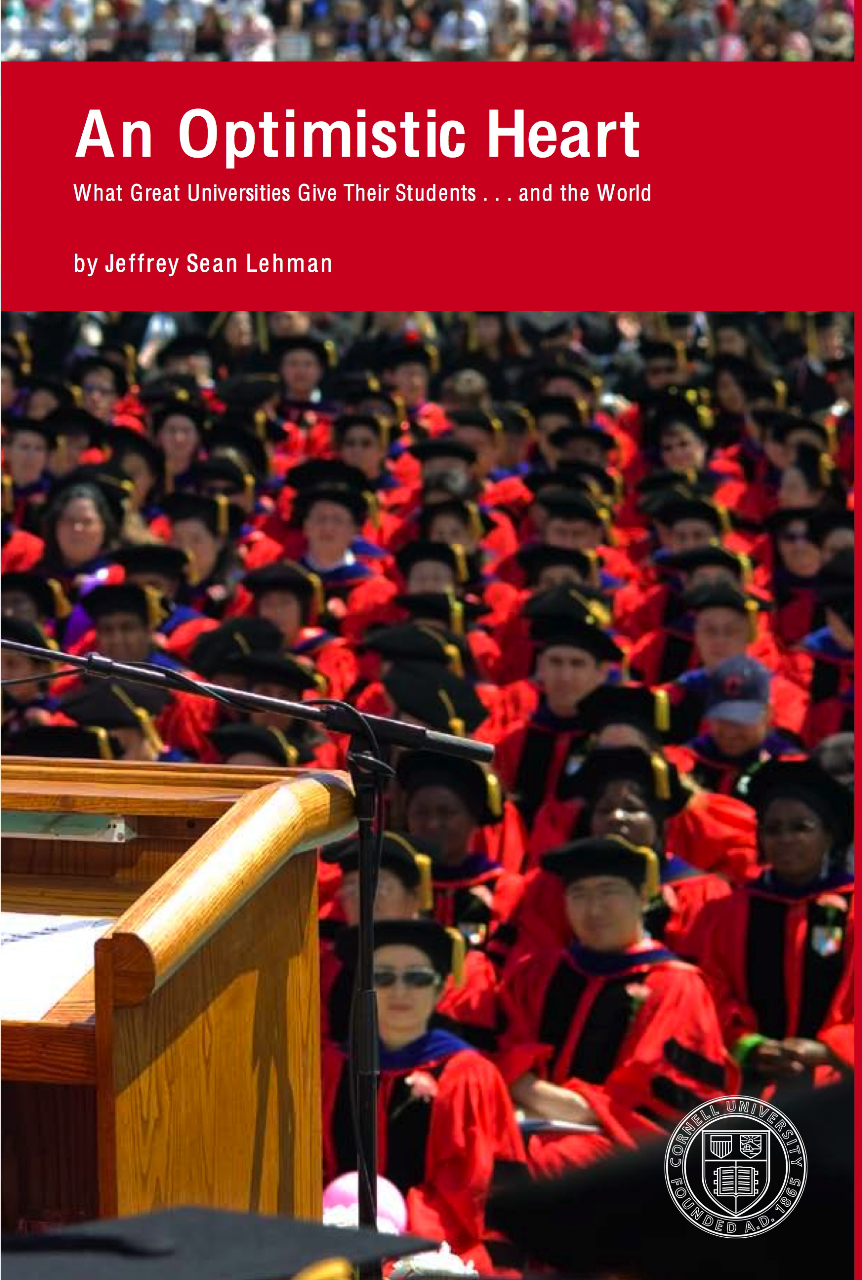
WEILL MEDICAL COLLEGE COMMENCEMENT
Jeffrey S. Lehman
Carnegie Hall
June 2, 2004
Thank you, Dean Gotto, and congratulations, new graduates of the Joan and Sanford I. Weill Medical College and Graduate School of Medical Sciences of Cornell University. I know I speak for your professors, the members of the Board of Overseers, and especially for your families and friends when I say how very proud we are of all of you.
You are the triumphant 2 percent of the nearly 7,000 who once applied to sit where you are sitting now. And during your time at Weill Cornell, you proved yourselves worthy of the confidence that we have reposed in you.
The research papers you’ve published; the fellowships you’ve won; the good news you received on Match Day concerning your residencies, all suggest that you are exceptionally accomplished, exceptionally motivated, exceptionally likely to go on to do great things.
But to sit where you sit today has required a team effort. No one earns a degree alone. Your professors and classmates, your parents and grandparents, your partners and spouses, your sponsors and friends have been part of the support system that helped you reach this milestone in your medical and research careers. They, too, deserve our recognition and our thanks today. I’d like to ask those who are not wearing caps and gowns to please stand so that we can give you a round of applause.
The world has changed dramatically in the past decade, and the changes we have witnessed carry important implications for the medical profession. This afternoon I would like to talk about three different dimensions of those changes – scientific, sociological, and geopolitical – that are having a significant impact on both clinical medicine and research. And I will offer you some suggestions for how you might integrate a response to all those changes into your professional lives.
Just before many of you began your medical education, the Human Genome Project was completed, and the floodgates were opened to a new era of research. I am not a doctor or a scientist, but in talking to doctors and scientists both here in New York City and on the Ithaca campus, I have sensed an overwhelming excitement. Excitement about being at the start of a truly new era in biology and in medicine. Excitement about being on the verge of figuring out something elemental about life and life processes. Excitement about working with people in another field who might be able to bring complementary knowledge and insights to bear on the problem at hand.
There is a realization that to appreciate the likely influence of a particular gene, one needs experts on plant genomics, animal genomics, and human genomics. To analyze the enormous quantity of data that specifies gene structure and protein structure, one needs experts on information science and computing. To understand the processes by which genes and proteins operate, one needs expert chemists, physicists, and engineers. To understand the ethical and moral implications of it all, one needs ethicists and humanists. And that has brought together the New York and Ithaca campuses in new and productive ways.
Many of you have been part of the excitement that now infuses the life sciences. To a degree that earlier graduates could not have imagined, you have already had your education and your research informed by knowledge that spans institutions and disciplines.
Twelve of you have taken advantage of the resources at Rockefeller University and the Memorial Sloan-Kettering Cancer Center as well as at the Medical College to earn combined M.D./Ph.D. Some have spent time on the Ithaca campus, working with faculty members and using the specialized research facilities available there.
Sociologically, we have seen the dawn of a new, research-based understanding of what it is that patients are seeking from their doctors. At one extreme, earlier models had suggested that patients cared only about health outcomes. At the opposite extreme, a next generation of models had suggested that patients care only about their autonomy, seeing their doctors as nothing but technical consultants who shared risk profile information associated with alternative courses of action.
But with the publication of Carl Schneider’s book, The Practice of Autonomy, we came to understand that patients care about more than just their autonomy. They want their doctors to respect their autonomy, but they also want their doctors to be competent and kind.
Kindness. A more personal relationship. Civility. More than ever before, doctors are expected to find ways to express their essential warmth and humanity in the course of their professional work. The ideal is expressed perfectly in Weill Cornell’s new vision of the ambulatory care experience, called “Weill Cornell: We Care.”
And as students, you have certainly pushed yourselves to engage the essential humanity of others. You’ve reached out to your classmates, across the boundaries of religion, and race and national origin in order to learn how to be the best physicians and biomedical researchers you could be. You’ve been involved in community service, and the graduate students, in particular, have reached out to mentor teachers and students in the New York City public schools. In the process you’ve come to know people from all sorts of backgrounds and with all sorts of viewpoints, including some that are probably very different from your own.
And geopolitically, the dangers and opportunities of the twenty-first century implicate the medical profession at their core. The scourge of terrorism has heightened our awareness of the need to have responses to all varieties of attacks, whether conventional, biological, or radiological. At the same time, it has also heightened our awareness of the need to engage internationally, to challenge ourselves to engage with each other and with the world, to make a difference where we can.
I believe that in this domain you can take a special pride in your association with the Weill Medical College. When we established the Weill-Cornell Medical College in Doha, Qatar, we became the first American university to offer a full medical education in another country. We enrolled our first class of pre-medical students to our Qatar campus two years ago. Some of those students came to New York and Ithaca last summer to study and carry out research, and the first class of medical students will begin studies in Qatar next fall.
I was in Qatar during my inaugural week last fall and again this spring, and I continue to be impressed by the extent to which Sheikha Mouza and the Qatar Foundation see education and health as keys to a better future for Qatar and for the Middle East.
Thomas Friedman in his New York Times column on Sunday expounded on what he called his Tilt Theory of History. “The Tilt Theory,” Friedman wrote, “states that countries and cultures do not change by sudden transformations. They change when, by wise diplomacy and leadership, you take a country, a culture or a region that has been tilted in the wrong direction and tilt it in the right direction, so that the process of gradual internal transformation can take place over a generation.”
I believe the Weill Cornell Medical College-Qatar is an extraordinarily hopeful venture, for Cornell, for the Qatari people, and for the world. It is helping to tip the Middle East in the right direction. So is the Bridging the Rift Center, a life sciences research center that Jordan and Israel, in partnership with Cornell and Stanford Universities, are developing on the border between those two countries.
So is our support of Father Peter Lejaq’s efforts, through the Bugando Medical Center, to create a health care infrastructure in poverty-stricken Tanzania. And so are all the personal acts of kindness that have been part of your daily experience as medical and graduate students, despite all the differences in background and perspective represented here.
You have been privileged to be at the Weill Cornell during a period of great renaissance, when the college renewed its collaborative ties to permit ever more significant contributions to human well-being. During your years here it has established itself as center of innovative education, pioneering scientific research, and transformative clinical research in what is truly a new era of understanding about human health.
Now, as Cornell-trained physicians and biomedical researchers, you are about to embark on lives of significance and service. And so let me conclude by sharing some hopes that we, as your teachers, have for you. I offered some of them to the Ithaca graduates on Sunday, but they are perhaps even more suited to those earning degrees medical and biomedical degrees.
May you enjoy the special pleasures of craft — the private satisfaction of doing a task as well as it can be done.
May you enjoy the special pleasures of profession — the added satisfaction of knowing that your efforts promote a larger public good.
May you be blessed with good luck, and also with the wisdom to appreciate when you have been lucky rather than skillful.
May you find ways to help others under circumstances where they cannot possibly know that you have done so.
May you be patient, and gentle, and tolerant, without becoming smug, self-satisfied, and arrogant.
May you know enough bad weather that you never take sunshine for granted, and enough good weather that your faith in the coming of spring is never shaken.
May you always be able to confess ignorance, doubt, vulnerability, and uncertainty.
May you frequently travel beyond the places that are comfortable and familiar, the better to appreciate the miraculous diversity of life.
And may your steps lead you often back to York Avenue and the Weill Medical College of Cornell University. For you will always be Cornellians. And we will always be happy to welcome you home.
Congratulations.
